Kamis, 24 Januari 2008

Selasa, 22 Januari 2008
Species

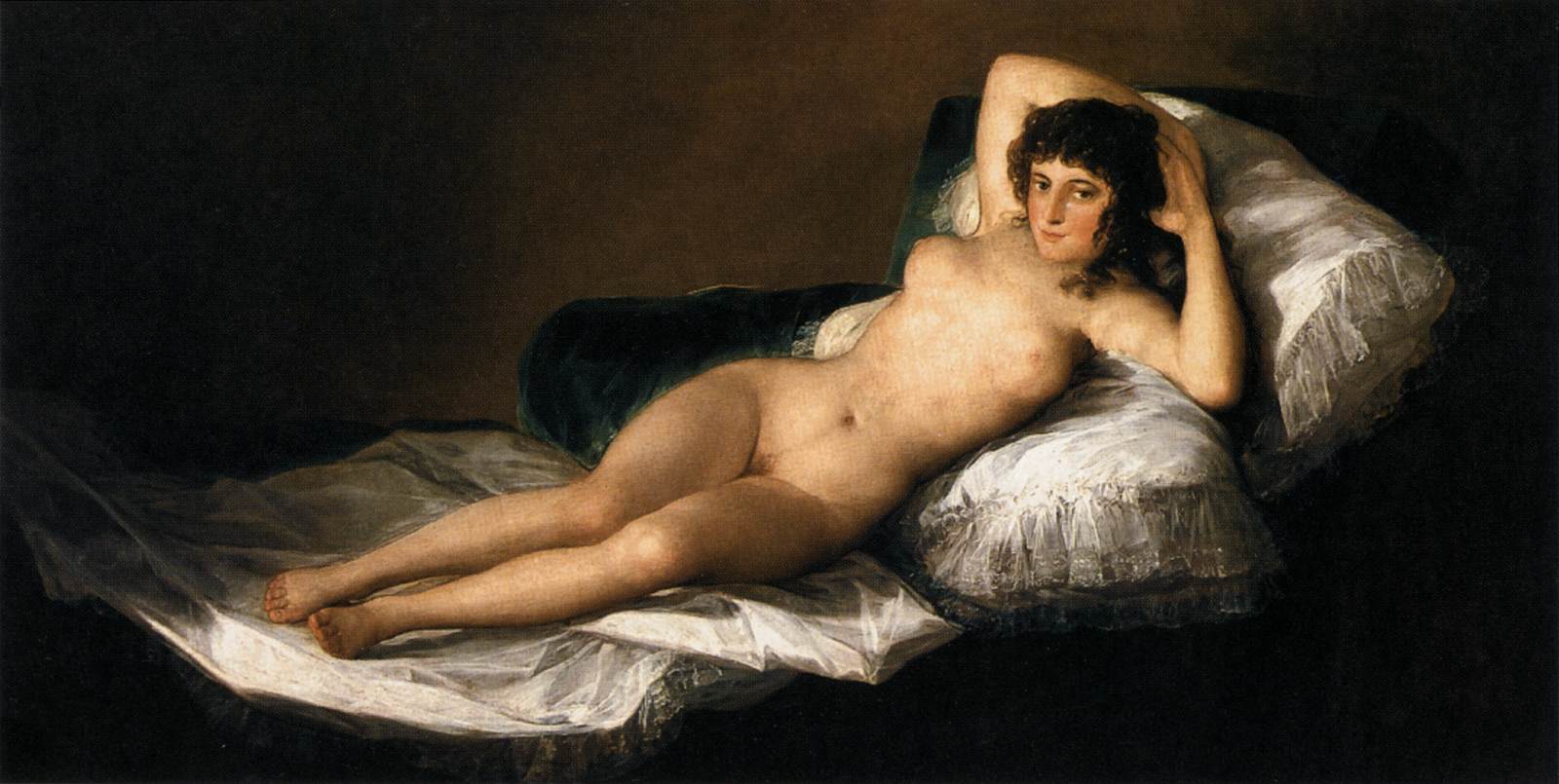
What is absolutely astonishing about this photo by Jill Greenberg is that it seems almost as if taken by chance. Although it is a carefully studied pose, its context is nowhere close to the conceptual play we see here. It is part of a series portraying primates in a relatively classical way - their faces showing somewhat human characteristics, with adequately human titles ("Anxious", "Dude", etc.). They are wonderful and funny pictures, but this one here is really something else. The title is "Mala Centerfold", and that seems an understatement. We are not in front of some cheesy centerfold here. Oh, no! - this is the real thing, this is the indecent Olympia, this is the lascivious Maja.
It is challenging Darwin to a truth-or-dare.
And it is delicious.
Senin, 21 Januari 2008
Selasa, 15 Januari 2008
A few amazing finds, and a very subjective text

Magnus von Plessen, Felicity
It is hard for me to imagine a live performance that would have (that I would find to have) the density of some visual art. Yes, I distinguish those quite clearly, mainly by the dilating of senses I experience when watching most performance, as if there was no way of just getting to the point, or points, or of just hitting me with whatever they have. "Just". There is justice in this just, a sense of the right measure, like an object where the proportions feel right. I simply cannot recall a single performance I have seen where the proportions just felt right. It seems time and a live body introduce elements that are somehow completely out of the scope of my spectator experience.
Compare the best you've seen on stage to this:


The above images, by the astonishing Tim Hawkinson, are more than powerful: they range from publicity-like to classical sculpture to highly conceptual (the last one is a self-portrait mapping of all the area the artist sees on his own body, the picture before is a Balloon Self-Portrait, a blown-up mold of the artist), and yet each of them seems complete.
Or see these, by Huma Bhabha:


How are we to compete with the perfection of something that is? Another language, you will say. Another state of presence. And yet, the choice of what to lay my eyes on remains. And diversity is no argument, when time after time what is live seems to be disappointing, less thrilling, less surprising, exciting, fresh and bold than what remains there not waiting for the sight. But then again, it is also less exciting than film, which seems only to live when seen!
Indeed, it is perfectly useless to speak of the spectator's responsibility in all this, when the spectator admits he is not up to it and instead choses something less desperate, even as it may be darker and, at least on the surface, less active.

 (Both poor quality reproductions are by Magnus von Plessen)
And yet, after having written all this, I still feel that live art somehow retains an incredible potential. Not because it is live, at least in the sense of having live people in front of you, but rather, in the sense of it being an event, and so, something that remains unexpected, but also unfinished, incomplete, and fragile in its egomaniacal form ("look at me!"). I'm still not sure where this is heading, it remains confused, but it might have something to do with the amazing phenomenon of enjoying something while it is bad, enjoying it because you appreciate it as an event, enjoying the fact that you are in the privileged position of
PS: Here is a picture dedicated to the effort of some colleagues from a theater project that has been on these days:
 (The picture is by Amy Stein. I believe the title is Domesticated.)
Rabu, 02 Januari 2008
Duane Michals and Schroedinger's Cat


I really shouldn't. The above work, created by Duane Michals, should be left without a comment.
But how can I resist?
First, let's clear up one issue: anyone trying to better understand the Schroedinger's Cat thought experiment by getting acquainted with this work may be misguided. Although the work plays around with the idea of ontological ambiguity, its way, focus, scope seems to be different from that of the famous scientist. Nonetheless, I am sure Schroedinger himself would refrain from saying such a silly thing as "I wish I had never met that cat", had he gotten acquainted with this little beast (and its charming mistress).
Now, would you look at that. At the delightful play with the point-of-viewness (also, under various other circumstances, called perspectivism or sollipsism or more broadly subjectivism), this attitude of turning the object (of the onlooker) into a subject, and the subject (the spectator, the admirer of the work) into an object (the looked-for, if not the looked-at) is not only a development of motives in art and in philosophy, it is an exquisite retro (the work comes from 1998) portrait of a relation.
This relation is based on faith. Were we to know the cat is in the box, we could not feel the bond the way we do. And yet, this faith does not move mountains. It neither saves the cat, or condemns it. It is rather a sort of a "suspended disbelief" kind of faith, when one ponders, but accepts not to question what is impossible to discover. But this faith also includes accepting not to affirm, as a sort of worldly agnosticism. How are we to deal with what we cannot know or control? It comes to no surprise that Duane Michals cites Zen Buddhism as one of his influences.
Of course, the last picture is a light and funny way of escaping the question (into a new question), but the first two remain. And in them, especially in the first one, there is a hidden level. In Schroedinger's example, the cat is either alive or dead. So when Madame Schroedinger wonders if the cat is or is not in the box, she might not expect the box to be empty. So the question becomes: what is it that makes that presence so present?
The further we get away from the first picture into the next ones, the more delightful the experience becomes. But also the least powerful. From an existential inquiry into you-know-what, it turns into a fun - but not too ambitious - looking-outside-of-the-frame. The work looks at us? Yes, we know. Not a particularly new discovery. And to be honest, it doesn't need to be. Less ambitious? Maybe, and then we can always say, "Who needs ambition when there is such a splendid onlooker peeking out of the box?" I would rather say that since there is no way of knowing the answer to picture number 1, we might just as well accept that and move on. To another possible world - and yet another. Ours.
Question: Have you noticed the box on the first picture might fall if the cat is there and moves as a cat that is there might? Oh, Madame Schroedinger, snap out of it!
Question 2: Have you noticed how much bigger the box is in the 2nd picture? (And how it becomes a non-box in the 3rd...)
More about Michals in this great article.
Found the work here.
Minggu, 30 Desember 2007
2008
Congratulations to the very creative Spanish ad company DoubleYou (link to a non-site), who have various nice projects,among them the ingenious DoupleYou Loop.
Jumat, 28 Desember 2007
Jonas Dahlberg - the melancholy of illusion

There is a dark corridor, with just one passage through some light coming from the half-open door to a production room. The corridor is not long, so before I know it, I'm in a black room. There is apparently no light, except for three large, very, very dimly lit images. Actually, they seem more like windows, as what we see on them are interiors - at first glance it is hard to tell whether those are three rooms, or the same one. The rooms have a sensual, soft light, and everything about them seems dream-like.

That is a very comfortable place to be, delightfully melancholy, hidden in the middle, looking out into the private zone, the excessively private zone of what might have been a perfectly regular set of spaces, were they not so hypnotically absent.

If there is something at once appealing and haunting in this triple view, I am reminded that there was a TV set in the entrance. I go back, and the curator Katarzyna Krysiak tells me that although the video is an hour-long loop, it will start again soon and is worth watching at least the first minutes.
So I put myself comfortable. And the same room I saw on one (two?) of the pictures appears. And then, it starts melting. First, the back of the chair thins to nothing, and it falls apart. Then, progressively, the lamp gives way, the bookshelf (how could I have not noticed it before?), the table, the bed... The whole wax model (as it turns out) vanishes bit by bit.
According to the curator, this is the artists reaction to a friend's depression. It is inspired by how a physical space changes in such circumstances.
Johan Dahlberg is a master of disguise. But his masquerades are not about people. Rather, Dahlberg masks space. In his work (check out his site for several other interesting examples), illusion is the basis for questioning our relation with the space we see and feel. It comes as no surprise that among his favorite tools are models of rooms (their doppelgängers) and surveillance equipment. But contrary to many commentators, I have some doubts whether we can define Dahlberg's work through the prism of the "Big Brother" universe. There is so much more in his observing of our observing of an object! Be it with cameras and screens, be it through the nomenclature of surveillance and false spaces. But see, for example, this work from 2000, (Untitled) Billboard,presented in the Swedish town of Uddevalla:


The wonderful quality I find in these works is their capacity to confuse our sense of space, and question the order we assume as self-comprehensive. How mine is this space? Where am I in relation to it? And how sure can I be of it, of what it is?
The exhibition I visited at the Foksal Gallery (on until January 11) is part of an entire cycle called Quiet Home. What is the degree of irony in such a title? That depends on where you find yourself in relation to it, doesn't it?
The pictures from the exhibition courtesy of the Foksal Gallery.
Photos of Untitled (Billboard): copyright Jonas Dahlberg.
Langganan:
Postingan (Atom)