Kamis, 13 Agustus 2009

Funnily enough

Life is Everywhere (2004)

En Epoch of Clemency (2007?)

Hedgehog in a Fog (2004)

Talent Can't Be Boozed Away (2004)

From Sindbad and International Terrorism (10 Heroic Deeds) (2006)

From Sindbad and International Terrorism (10 Heroic Deeds) (2006)

From Fucking Fascism (1998)

All works by the Russian collective Blue Noses (most known for the 2007 scandal one of their works provoked).

(Thanks Liz!)

Rabu, 12 Agustus 2009

Sensing discourse


"- What is the role of the artist?
- To not get tired of running all his life."

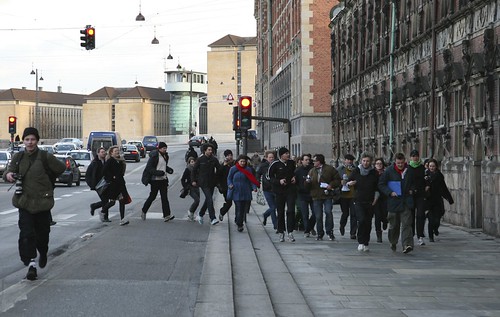
The Critical Run initiative, by Thierry Geoffroy, at first glance, appears exciting. Lighthearted and simple, yet livening. Take a group of people and make them discuss serious issues - while jogging.
Let's run and talk. Let's have fun and share. Let's move. See what happens - to us, to the surroundings, to the topic.
It reminds me of some of the Lone Twin works, and of other, more discursive, initatives.
But then you see the videos.


- and you realize why this is a copyrighted format. Actually, it's not about the conversation at all. It's about the hilarious situation of displacing discourse into a territory that is not its own. It's about creating a mess with a mass. And hoping (?) for a miracle of super-discourse through a discourse-smashing environment. As we all know from films, the most profound ideas arise on boxing rings.
But wait! It gets better!


Oh, Canada!
Think! Exchange! Travel far! As long as you can fit it on a headband...

But let's be honest. Discourse is a problem for the work of art, if it stays within the aesthetic experience. It either gets chewn up by the experience or we move out (last movement?) of the aesthetic experience and into the realm of plays-on-ideas. Which is also a tough blow.
Then we have to face the perspective of functioning as anyone else who thinks. And running with them. And quite possibly getting completely lost, syncopated, out-of-breathed, shafted, as my teenage years would put it (notice the momentum of the word). No wonder one can feel the need to go back and, well, try to, well, do, well, something about the loss. Someone like John Baldessari*, witty enough to both play the artsy world and keep his eyes on the ball:


And, to get a fuller picture, how else, a remix of the remix:


Is the relief you feel when being able to read accompanied by a feeling of the loss of Baldessari's purity? Could it be there is not enough movement? But then again, isn't it nice to feel that a words translates into a thought?
One of the videos of the Critical Runs is entitled "Does the artist has any impact on society?" (sic!)
There is one comment underneath: "Not in bad English you don't. Does anyone have..."


* For a succint intro to John Baldessari, see the stylishly designed FLYP magazine.

Selasa, 11 Agustus 2009

Kamis, 06 Agustus 2009

Wooster Group's Hamlet (aftermath)


This is not a review. And it will probably remain incomprehensible if you don't at least read what the Wooster Group show is about. So you might want to start off with a positive review and/or a negative one.
(And, possibly, move to an insight into how they prepared it. And an insightful interview about the group. And an interview with Kate Valk.)

I had been waiting to see this for a long time. This is the group I always talk about during workshops and I have never seen act live. This particular show, well, could be an experimentum crucis of my (wavering) faith in theater as a live form of live art. I leave you with
my transcribed raw notes from the show, and below, a couple of ideas.


Theater as reproduction
- of what?
of our reality
=> cinema (is our reality)

other way: reality reproduces art
body is our basic reality

body as choreography

BUT it's first and foremost a SHOW

spaces of absence

The dance of the impotent body

to perform = to enact

puppets

retro

conventionality of movement

performance as video art or rather as
echo of image
=> afterimage

--

The action lies between the acts

--

Playing on the players like on instruments
The players accompany a great
video
Is that bad?

"They killed theater" (audience member, calmly)
(So many deaths of theater before)
Good Heavens,
if that be so,
if this is the thing,
I humbly thank you.

Musical work - when works.

Women (Cate Valk, really) have more problems with show formula- because of
more emotional roles?

2nd part much better - uses the new convention.
(but also ends up more conventional)
Hamlet - actor - manipulates the actors - logical gesture.
Strong
--
search for an
aesthetic experience
(e.g. songs)
showSHOWshowSPECTACLE
---

Warping time/space

But then it becomes simply multimedia entertainment.

+ + +


A man crosses the stage, says Peter Brook, and you have theater.
Pathos. That's what you get when a man crosses the stage. Anthropocentrism. The idea that it's all about us, really. The sin of vanity in all its splendor.


Who are we, really (on stage)?
How do we conduct our paths (on stage)?
What can we see if we introduce breaks into the surface of our behavior (on stage)?

The body becomes heavy.
It becomes an accessory. An object more than a tool. An instrument that cannot be played in a clean way is more of itself. It is less melody, and more instrument.
This body that struggles to fit into the image that will always outsmart it.

Their "on/off" stage presence (in the middle of a scene: "Let's skip this dialogue") is not shocking, it is part of the language of contemporary performance. It is part of our thinking, feeling of the frame/work of art as ambiguously present, intermittently present. Nice: it's when it turns us on, not the other way around. Hence the decadent flirt, hence the false opening, hence the play outside of a play outside of a play.


______________________________


What do you want out of this? Out of this experience? What do you want out of a play?


Try this: Say: This is silly. Say: Theater is the essence of the misconception that it is all about the human. It is the place of the old-fashioned, stubborn faith in 1) the communion of the believers, and 2) the hierarchy of presentation. It is a stage which seems so enchanted with the universal human condition, it forgets the subtle yet profound changes of the aesthetic, the sensible, the eye of the beholder. It is a place whose very existence in these times is so out of joint, it is funny.

But what if we accepted this as part of the game? What if we played this game, using this as a platform to inquire into what conditions we are in, as the humans that have no choice but to, at one point or another, remain anthropocentric? What if we surrendered to the collision of times, this our present time of, say, having to read this text one line at a time, and the time of too many lines behind, and the time of too many lines besides, after, above? What sort of figures are we once we let go of our need for the unique now? Entirely?

Sensation> This our too too solid flesh is extremely flexible. And it goes along with the lines of tension, it follows the cracks and bounces off whatever is left as the aftermath.
Abstract? No, this is not abstract. It means: somehow, miraculously, we deal with change, since we live through it. And yet, we do not melt, we do not resolve ourselves into a dew. If we manage to tune in - we dance. Every step, stumble, vibration becomes a choreography of ourselves.

Sensation> We are not enough. The body fights to correspond to the twitches of the images, yet it lags behind. The eyes go back to the screen. We have no way of knowing how correct we are, yet the need of knowledge unveils our total, complete inadequacy. We are but thinking puppets, we are but repeating Plato, we are but warming up the stage for the image that comes behind. Whatever surrounds us is more powerful, and yet -

Sensation> The eye of the beholder might make a difference. The beholder as object, the beholder as a weaker alter ego. The beholder as the one who submits to the role of a prop, and whose tragedy, a subject realizing he is an object, becomes the juiciest work, the perfect crack in the façade of the perfect spectacle.

Oh, and don't pay attention to the ending. Don't pay attention to the illusion that the slave has become the master, that the technology is, after all, a tool, that we can use the past, control the present, cope with the future, that things are what we want them to be. Don't fall in the trap of theater, which numbs us into believing it's okay, images end, we are here, devising our entries and winning our exits.
There is a stage behind that one. But on it - well, take a peak.


Kamis, 23 Juli 2009

Lapidating Modern Art


A few days ago I witnessed an excessively sad event. A huge group of merchants was thrown out (by the police) of a hall in the center of Warsaw (which they had been renting for several years), and the events turned violent and nasty, with throwing of stones and fights and tear gas and general havoc.
Although it did look like some sort of incomprehensible flash mob or other performative party, one could hardly squeeze it into the “new art” category, were it not for one significant detail: the commercial hall is to be substituted by the Museum of Modern Art. Of course, the city authorities claim the undoing of this most hideous hall is necessary for the construction of a second line of the metro, but the fact is: the temple of 90’s-style small, bad quality commerce will be replaced by the temple of contemporary art.
The obvious implication of this week’s events is: the Museum of Modern Art will arguably be the most despised building in Poland. So far, the only (extremely heated) debates about its character, name (Contemporary or Modern?), and, of course, its shape, interested only fairly elite circles. The building itself raised most controversy, with its austere, “modernist”, or, as some put it, uninspired look. But all this was nothing compared to what happened last Tuesday: the masses moved. There was naturally no talk of the museum. Yet sooner or later, the topic will appear. The Museum will be built, and the tens of thousands of people around the country who considered what happened an act of injustice will have a surprizingly clear symbolic enemy: Modern Art.

But the hundreds of people gathered at the hall entrance would not be customers anyway. Meaning, they don’t fit the profile. Not the current one, and not any potential profile of someone “we” seem to want to educate into (our) art, into (our) culture. Why? Because the social differences are so big, it is still unimaginable for the common art curator/cultural agent to think of these people as spectators, art amateurs, partners. Just as they were hardly a partner for negotiating a new commercial deal (they rejected several offers and refused to participate in further negotiations). We will hear: They are outside of the reach of... of us, the cultural people, the elites, the-educated-ones. They are a lost case.

This is obviously the moment when the conflict becomes helpless. Each party is convinced that the others are barbarians, their entire world is wrong, corrupt, and unworthy of any contact.

Do these people need us to defend them? I believe this is not a question of need. It is a question of true access to culture. Of initiatives, or rather, structures, which would allow for a potential integration of all citizens.
The Museum of Modern Art has already had many great exhibitions. But these initiatives are clearly focused on a prestigious audience, they are intellectually sophisticated, but beyond that, they don’t seem to reach out to a “larger” audience. This reaching out has been happening in many museums around the world (take the Brooklyn Museum, with their great program of interactive activities where once a month visitors can have a totally different experience of art, which includes, for instance, making their own art prints and parties with known DJs).
In Warsaw, we have a truly outstanding exhibition relating to the great Alina Szapocznikow, an artist whose work is largely unknown outside of Poland, yet here is already considered as a crucial reference for anyone interested in modern art (the exhibition ends Sunday). Her works combine eroticism with power, femininity with a great understanding of structure and drama. Possibly the most impressive among the works presented at the show is the huge female belly sculpted in marble (actually it's a double-belly), which impresses, attracts, scares, and ultimately leaves us at a (as always unbearable) distance. What is made to counteract this distance in terms of programming? Some lectures, discussions, guided tours, and a new documentary film. All this is great for me or you. Interesting indeed.
But what about the reaching out? The search for new, active audiences?
Well, many of the women present during the events at the commercial hall were convinced to join in the creative thinking about stone – they reached out, grabbed the pavement stones, and threw them at the police. I claim they did it not only because they were “part of the mob”, but also, because they were hardly ever offered any serious alternatives.
Isn’t it time we thought about those others as true potential consumers of culture, who can be sought just as we seek the already accustomed artsy amateurs?

A friend of mine suggested that the 2000 salesmen thrown out on Tuesday be hired at the Museum Store.
Beyond this ironic (and hilarious) take lies the feeling that something is going terribly wrong in the way we are approaching the idea of social change.
I have been often showcasing projects with social agendas. They were more out-going, accessible, they were social sculptures or other initiatives which claimed a different approach to the audience-connection.
But at such instances, I wonder: can't social sculpture strive for effectiveness? Isn't it terribly passé to hide behind our we-are-only-poor-artists shields?


PS. The Museum of Modern Art does attempt to create a social space of dialogue, as in the initiative of a Park of Sculpture in a poor part of Warsaw. One can see the idea. Yet paradoxically even an artist like Rirkrit Tiravanija seems to have transformed of his relational aesthetics here into a... well... esoteric sculpture.
Hopefuly, this cube, and tens of other artcubes, can make a difference. Yet for the moment its futuristic, mirror-like shape seems all but ironic.

Sabtu, 11 Juli 2009

Anthill sculpture

It's my birthday, so today I'm leaving you with some new art that was not meant to be art, made by a scientist in collaboration with ants... (Don't mind the off-screen commentary and enjoy the visual ride).


(If you're interested in the ant-not-art part of it, you can see the 6-minute documentary episode here)
(Thanks Pusty!)

Selasa, 07 Juli 2009

Surfacing

Remaining on the surface is challenging.
Going deep means losing the precious cristalline equilibrium of form.
Going indepth means losing the surface tension, the attractive property, as Wikipedia nicely put it.


Picture one is
Leak, from an ongoing project by the G&V (with credits to Matthew Chokshi) The second picture is called Z. and is by Lin Zhipeng, aka "No.223".