Jumat, 17 November 2006


Delicious.
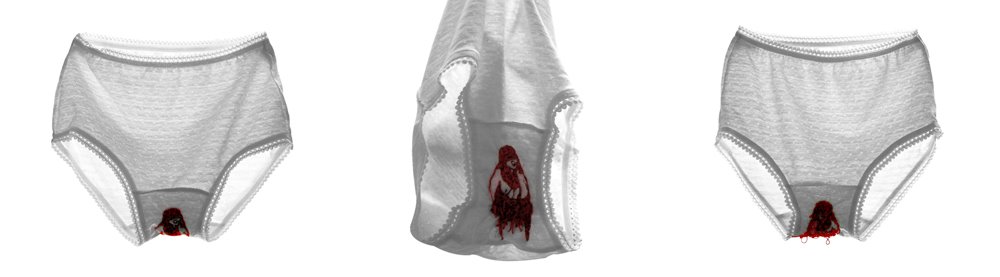
The only thing that irritates me here - and I suppose that's just a silly problem - is that the brilliant guys that created this, Winkler and Noah, have absolutely no problem whatsoever selling these wonderful, environmentally friendly messages...

... and next to them, selling some of the most environmentally unfriendly ones. It's as if there was no difference. Who are they, you might say, to decide on that? They simply do their job, and that is, to come up with something that sells well whatever it is its supposed to sell. Hmmm... I guess you're right.
But just go beyond the surface of it's all the same and compare this to Adbusters. While Adbusters try to be the Good Guys (with all the risks that are part of it), Winkler and Noah would be an example of the UnGuys - neither good or bad. Excellent quality for sale. Sound right?

(via)

Kamis, 16 November 2006

The Perfect Gift


Keep the world full of surprises.
If you don't have any books to cross, and are really not in the mood for a birthday party performance, then think of something else. Make it fluffy, hard, shiny, matte, transparent, sticky, disgusting, funny, shocking, simple, personal, whatever you make it,
hide it.
Anywhere you want, as long as it's a place accessible to anyone.
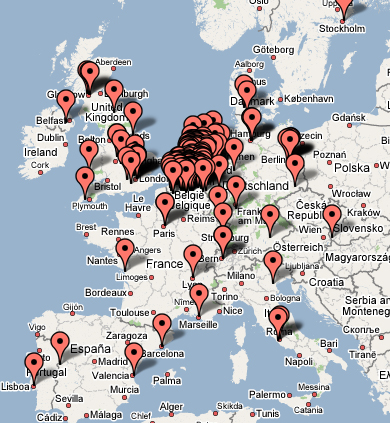
Then, go to Drop Spots, and put your drop spot on the map. So far, it seems to have been extremely popular around Belgium and the Netherlands. I suppose the authors - Brijetta Hall, Dan Phiffer and Ed Purver - might have something to do with it?
So far, there is only one drop spot in Lisbon. Hopefully this will quickly change. I'll try to participate as well.
(There isn't a single drop spot in Poland! Get to work, people!)

***

How far are we today from the first experiences with 'pervasive internet' by the folks from Blast Theory? Not very far. The gaming industry is getting all happy, there are new initiatives (especially with locative media, but not only - see this absolutely amazing site with pretty much everything you thought was possible already cataloged). But one can feel all this is still very young. Artists don't really know what to do of all these possibilities. It seems like the world is suddenly too large, not too small. And so these are small experiments for something that, I think, will be much more impressive, overwhelming, and deep-going than anything we see around today. Are you as curious as I am?

Selasa, 14 November 2006

Layers

Of course, of course. This is not what it seems.
This is not a concrete column. This is not graffiti. This is something entirely different. It is a picture, a photo of graffiti. It is printed on dibond, the type of aluminum that is used for traffic signs, for example. And these metal sheets are then screwed onto a plywood construction. And all this is put in a different, non-street setting (in this case, the «lovely Dicken's Library of the Mary Ward House, Bloomsbury, London», but in another, more gallery-like setting, which make it seem much poorer, almost as if it were a strictly site-specific installation).
But what is striking about this is that it is exactly what it seems - a dislocated object, a rupture in reality, an addition that questions its context. In that sense, it is correct to say this is a column with graffiti. Because here, in this space, that is what works, what creates the tension. And then, all the other levels come into play, in this sort of a hide-and-seek of «objectiveness». It all stops somewhere, because it is a self-commenting (self-referential, if you like) convention. It plays on the very fact that it's a fake. And that it is still incredibly near to reality. So near, the showing fragments of plywood actually seem glued onto the concrete pillar.
The fact that the installation is in a library seems crucial (no matter why it actually got there). It speaks volumes about what we are, who we are. Our «means of expression» and aesthetic values and the gut need for destruction (or is this just me?). At the same time, it is a taming object. It tames the defying attitude of the original by turning it into a slick, clean, savvy copy of itself. Now, this is the pillar of knowledge. Of civilization. Of us. It is what sustains - or what makes us believe it sustains the heavy walls of our libraries. And if we ridicule it for being a fake structure, we might just bee too confident in our own walls. Underestimating the actual proximity of the object, and the image.
Kristin Posehn, Replicant (2005-2006)

Sabtu, 11 November 2006

Magdalena Jetelová. How much should we know?

See this>
These are powerful images. Dark, quite genuine in their landartishness, in their hands-on approach to the material. No gimmicking with the pictures here, just plain, gloomy black-and-white pulp.
My recent lectures, concerning Shakespeare, his work and times, put these images in a great perspective. What is the disappearance of the battleground? And the rupture between violence and human territory? Is it about the transmitting of the violence as a value, from generation to generation? An ever-available tool? Then the battleground disappears, since war becomes a state of mind rather than an act, which is but its realization. It is the possibility of all wars against evil, be it another culture ("barbarians" means "the foreign ones") or another, more sophisticated concept required to execute the inherited right to violence ("war on terror", of course...). So the battleground disappears, and there is a rupture between violence and human territory - because it isn't about the land any more. It is about identity. About preserving what is mine, because it is mine, and because it is what it is and is in danger of becoming what it is not. Suddenly, seen from this point of view, war is everywhere. It is unbearably flexible. It becomes this dark, black mass that is there.
Then there is another level. Atlantic Wall is the title of the series of pictures by Czech-born artist Magdalena Jetelová. The Atlantic Wall, (ever heard of the Siegfried Line?), were huge fortifications made by Hitler during WW2 along the coast of the Atlantic. What does that knowledge change? How different is the spectator's position? Now go a step further in the mythological aspects of the Atlantic Wall. And now, go for an informed review. How does your response to the work change as you discover the various layer? Does it necessarily get «better»? You don't need a spoiler to make it a spoiler. In this particular case, the Atlantic Wall looked at with all the info, seems like a mere illustration to a book. A beautiful illustration, but not more. It is very difficult to forget. Go back to all this Shakespeare, which from this perspective can seem like naive babbling of an ignorant.

Among Jetelová's many great projects, one of the most powerful ones is the Domestication of a Pyramid (to see more pics, on her site go to global-pyramids, then click on pyramid corners).


Once again, my silly question: How much should we know? In this case, I preferred to remain innocent and not inquire. After all, once I know, I cannot unknow, can I?

Senin, 06 November 2006


The Thought Project by Simon Hogsberg is very close to the spirit of Sophie Calle, with a slight postsecret twist. Here, too, the idea is simple: ask strangers what they were thinking at the very moment you stopped them. What impresses is the quality of the answers. It seems everyone here is either a writer or a character in a book. That is the impression I have gotten when (rarely) I had the chance to see/read Sophie Calle's work. How can the world be so filled with these amazing characters, these wild thinkers, these witty artistes... Don't get me wrong - not necessarily complex, deep thinkers. But... good people. Ben Harper asks Where'd all the good people go. To the Thought Project.
Then again, Hogsberg interviewed 150 strangers. And on the web page have 55 of them speaking. How was the choice made? In this case, isn't art the sort of science which can allow itself to be subjective, to be flawed, to be partisan? Don't we deserve some hope?