Selasa, 17 Oktober 2006

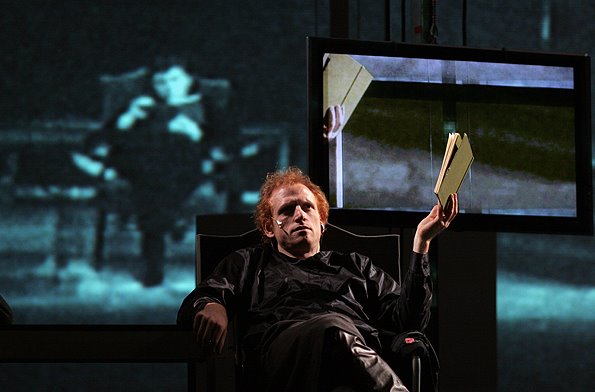
Why I like Elizabeth LeCompte

Wooster Group, Hamlet (2006). Photo Paula Court

Everything I come up with in my head, I put it on stage. But in 90% of the cases it doesn't work, precisely because it's in my head.


I think about what the audience will think. Every single moment. I want to be there, every evening, and observe what people do when they watch the play. If I feel them disengage or feel uncomfortable, it forces me to think about what I really want.

- Elizabeth LeCompte, artistic director of The Wooster Group, in an interview with the French review Mouvement (no.41, oct-dec. 2006). (my translation)

Do the above two quotes appear innocent to you? If they do, you probably don't have much contact with contemporary performance. These two sentences are sure to shock a lot of the avant-garde purists out there. The second sentence is simply a shocker: a seemingly avant-garde artist thinking about the audience? How dare she! She is supposed to be focused on art, on her experience, on the stage, on the essence, or on the periphery, but hers and hers only. The public should be the witness of something beautiful, not a criterium of artistic choice... Oh, how tremendously, absolutely silly. How pretentious, snobbish, irritating. How old and tired and, silly, just silly. And naive.
Notice LeCompte doesn't say the public's opinion decides. She doesn't say she changes everything if the public doesn't like it. But it makes her rethink. In her own words, "it forces" her. She doesn't feel there is really any choice. Is there? Certainly. You can turn your back to the ignorant multitudes and do your own thing your own way for your own self. You can have an inner voice that says this or that. You can be forever faithful to this voice. It's up to you. Or you can have a little modesty. And listen. And respond. Or not. But listen.
The first quote has to do with creativity on stage. LeCompte has no problem saying she has ideas first, then she comes into the rehearsal space and tries them (all!) out. Instead of doing it the traditional, "new" way, devising everything together in one pretty melting pot. Instead of making everything appear out of improvisation, as is expected from a performance group. And if that were not enough, she admits that yes, 90% of her ideas suck on stage. And she doesn't see any problem with that. And it works.
(at least I hope it does. if you want to confirm - go see The Wooster Group's Hamlet at the Festival d'Automne in Paris, Nov.4-10 at the Centre Pompidou.)

Minggu, 15 Oktober 2006

Fixing theater

In the next couple of years I'm determined to make a couple of independent short films. I' m disappointed by a great deal of theatre. I love it, but I am beginning not to like its transience; as I get older I want to do something fixed.
- Pete Brooks
found here, along with a couple of other great quotes from the book On Directing.

Videoart contest

Magmart | International Festival of VideoArt | 2nd edition

"Is now starting, till February 2007, the 2nd edition of Magmart | video under volcano, international festival of video art.
The festival is a production of studio tad, with partnership of Casoria Contemporary Art Museum, GenomART and Computer Arts magazine (italian edition)."

Enrico Tomaselli
festival staff
info@magmart.it
http://www.magmart.it
Skype: MetaArt

Aram Bartholl is playing with your life


Aram Bartholl
, First Person Shooter


Pretty self-explanatory. Among Bartholl's projects there are several ones playing with the idea of an "online" gaming world. It is all light-hearted, smart material. Taking oneself just seriously enough, but for heavens' sake, not too seriously! See, for example, this charming film from the WoW project:


(if nothing appears, see here)
Notice that the first work shown here seems to be created by someone protesting against the violence in video games. But discovering the artist's portfolio makes us realize he is rather someone who has been working (among others) on the crossing between real life and the gaming reality. This hides a very interesting and delicate issue: the spectator usually expects the artist to have some sort of an agenda, a declared ideology that he would be pursuing (here, it could be pacifism). Instead, artists often work on a vocabulary, a particular language, rather than an idea(l). Matter forms itself in a certain way and the artist, like the first spectator, discovers its dynamics and its possible readings. Especially in the world of theater (though not only), this makes a lot of people uncomfortable. The idea of an artist as someone entirely in control, like some mad scientist who knows what he is inventing (!) makes it difficult for many artists to assume: this is what I discovered, I'm not sure what it is, but I like it, and I hope we can all find out more about the potential vectors of this...thing. As Goat Island puts it, "we have discovered a performance by making it".

Rabu, 11 Oktober 2006

Since we're on the light side

Visitors to Paul De Marinis' installation A Light Rain (Helsinki, 2004) were given an umbrella to walk into the rainbow and listen to the music played by water.
De Marinis is also known as an electronic music composer, and a recent installation of his was featured at we-make-money-not-art. Personally, I like this one more - it's technically much simpler, but to the point.
Also, I really wouldn't need any music, and think it might fit better in the middle of, say, Lisbon, where the summer heat would be enough of a motivation to dive into the rainbow - no need for umbrellas or such. I know the umbrellas serve as speakers, but it looks like more of a gadget than anything else here, there is something wrong about it in this case. Maybe it's the isolation from the rainbow? Or maybe umbrellas simply have a sad relation with water.
(via)

Selasa, 10 Oktober 2006

Carsten Höller at the Tate: Are we having fun yet?

A rose is a rose is a rose. Only each time it appears in a different light, in different hands, in different eyes, the name of the rose changes. If the above statement was as obvious as we would like it to be, if it encompassed all possible interpretations (of the world, of art), the world would be boring. Relativity only goes that far. Fortunately, things have a tendency to take shape. To taste, to appeal, to be somethings. And I wonder if this is not exactly why a lot of contemporary art works so well for me: this tendency to be defined - and not the opposite tendency to be all-relative or blurred!- is what gives it the tension, the controversy, the attraction and power.
A slide, in art, can hardly be a slide, can it?
We feel its tendency to be a slide, but it's this very change in definition, this provocation of designing it as something-else, something-more, some sort of hidden being, that brings about the blush of art experience.
There are several reasons why this slide can't just be a slide. 1) It is set at the Tate Gallery Turbine Hall; 2) It is considered a sculpture by its author; 3) It is considered a sculpture by the art milieu; 4) I feel like seeing it as something else (a sculpture, a performance, a social experiment, an undefined set).
Each of these reasons has an entire theory attached to it. Points 1) and 3) are closely related, they belong to the "institutional definition of art". Points 2) and 4) are both part of the "subjective definition of art", with some important differences.
But why bother defining? What does it matter? Can't we just enjoy the ride?
We can. Yet, we don't need to. And since art is to be an enriching experience (even if not always and not necessarily a pleasant one), why limit ourselves? Thus, the art amateur will know (what a scary word!) what he is dealing with. He will take pleasure in discovering all the undiscovered worlds that a quasi-ready-made (post-ready-made?) gives us. He will be extatic about the many directions, readings, he will talk about verticality, and danger, exhilaration, and pleasure... It has to do with enthusiasm and letting go, with laughter as an aesthetic experience, be it of the one laughing or of the one watching others laugh. The problem is, the deeper we go into the theory, the more concepts we use to describe the slide, the further we seem to get from the first purpose of the slide - to make us slide. Sure, we can consider it a wonderful performative installation, we can stay contemplative and look at how grandiose and imposing it seems. But all this would be nothing if there wasn't the sliding.
It seems only logical that the installation be presented at the Turbine Hall. This is another turbine, a machine that we fuel. By forcing ourselves to forget the conceptual grid, with its heavy chunks of grey cell mass, and diving in. Only then does it seem possible to believe in the
utopian vision of a world in which slides are a means of getting from one place to another, an alternative to stairs, lifts and escalators.
And only then does this whole affair appear as fun, appealing, and something that actually works, rather than as a funny but futile game. (Unless, of course, we accept art as being futile anyhow.)

Is there a difference between this slide and any other slide in the world? Any substantial difference? Not to me. Which doesn't in the least take away the value of this particular work, as art and as slide. Because thanks to this one, I will cherish watching slides, and sliding, even more. It brings a new starting perspective, like a paradigm that allows to see things with a previously unfelt freshness. I could hardly expect more from art.

There is a lot of time to visit the installation: Carsten Höller's Test Site, as the work is called, will stay at the London museum until April 9, 2007. More about the work: good article, excellent interview with the artist, medium article with a flash/podcast presentation, medium article but with the only note of criticism, original Tate site. Finally, the source of the photos.

PS.: A friend pointed out that to go on the large slides one needs a free ticket. Now that's a way of making you feel you're sliding art.

Rabu, 04 Oktober 2006

Levels

The new work by Verónica Conte is called Stratification. It is what I would call a 10-day sculpture, or rather, an evolving sculpture captured in a picture. More frequent visitors to this blog will immediately recognize that I am hinting here at the dramatic - and yet so necessary - moving from object to picture. That actually puts the virtual spectators in a great position: it admits the value of the experience of seeing a picture of a thing, like a document, instead of a real thing.
But what is the real thing? Or rather, what is the value of the real thing? It is barely the touch, the touch that can be done in so many ways. Of course it matters. Take, for instance, other pictures from the same series, only re-mastered by me:
This seems like an entirely different universe. It is leading us towards a different experience. The neutrality of the object is gone, as is its distance. It is now an intimate shape, a playful image, a play with sense and senses where what is shown is just hidden enough to be curious. It looks pretty - but also somehow fake. The lack of context takes away the pleasure of believing that it's real. Sure, it's a nice idea, but not much different from a drawing, or a photomontage. And as such, it might be too little to actually hit the soft spot. But take another example (also a Vvoi remastering):

The intimacy is blatantly clear. But more than that, the link to the ground is there. The egg is just an egg-shape, it suggests, but doesn't really reveal. This could still be happening. Then, there is the gel, here in the form of a mass, maybe like boiling water? And then, where is the secret? Is it deep down? Or is it in the dark zone between the tender leaves?
There is one last detail these particular pictures don't show: there is a root coming from under the egg. Nice touch. The Grund - reason, grounds, basis - is here. Nearly transparent. But not quite.