Rabu, 27 September 2006

Size matters?

I'm sorry. The post from two days ago was bad. I'm putting it offline and leaving only a minimalist version.

Claes Oldenburg and Coosje Van Bruggen, Cupid's Span

Size matters? How exactly?
----
Kant's distinction between aesthetic experience and sublime experience could mean that, for instance, when visiting a pyramid I am so overwhelmed by it, the experience ceases to be aesthetic and becomes sublime. If we hold on to this distinction, we could risk saying that the experience of art may be similar if it belongs to the same category: in this example, the Louvre pyramid can have a strong aesthetic effect, but it lacks the size that could overwhelm. Does our sensibility really work the way the kantian categories would like it to? I'm not sure. Today, size, even when we're talking about really large-scale sculptures, seems just another element of our overall artistic judgement (notice how we're backing up from the idea of aesthetic experience, though...).
---
Take a few works: Jeff Koons' Puppy, Douglas Gordon's 24-Hour-Psycho, and Chris Bors's answer to it, 24-Second-Psycho. Or even the Colossus of Rhodes a few years before.
Why, then, does playing with size/scale often feel like cheating? Is Kant the answer? Do we basically enter other categories here and become overwhelmed? If so, shouldn't the issue of the scale be ignored?

Jeff Koons
---
Then again, scale is balance. Looking for balance is also looking for the right size. The right ontology, the right way of being, as if we were looking for some sort of homeostasis, balance or harmony, a balance which has as much to do with the object itself as with the context. But is Michelangelo's David any worse for standing in the Accademia Gallery?
---
When Cattelan makes a praying Hitler, the strike of genius is making him small, like an innocent being. Because size plays a role. That means size has a character, smaller is cuter, larger is more impressive, etc.

---
But then how do we cope with pictures of things? Why would our imagination compensate so well in a model representation, but have so much difficulty in regards to the original?
---
Going back to Kant, we could say that playing with the size factor is an expression of frustration with other qualities. Take Oldenburg, for example. Here is a fragment of a beautiful text he wrote in 1961:
I am for an art that (...) does something other than sit on its ass in a museum.
I am for an art that grows up not knowing it is art at all, an art given the chance of having a staring point of zero.
I am for an art that embroils itself with the everyday crap & still comes out on top.
I am for an art that imitates the human, that is comic, if necessary, or violent, or whatever is necessary.
I am for an art that takes its form from the lines of life itself, that twists and extends and accumulates and spits and drips, and is heavy and coarse and blunt and sweet and stupid as life itself.
(...) I am for the art that a kid licks, after peeling away the wrapper.
I am for an art that joggles like everyones knees, when the bus traverses an excavation.
I am for art that is smoked, like a cigarette, smells, like a pair of shoes.
I am for art that flaps like a flag or helps blow noses, like a handkerchief.
I am for art that is put on and taken off, like pants, which develops holes, like socks, which is eaten, like a piece of pie, or abandoned with great contempt, like a piece of shit.
I am for art covered with bandages, I am for art that limps and rolls and runs and jumps. (...)
I am for the art of underwear and the art of taxicabs. I am for the art of ice-cream cones dropped on concrete. I am for the majestic art of dog-turds, rising like cathedrals.
So, in the case of Oldenburg, where is all this art gone? What is it that makes one move from the majestic art of dog-turds to huge post-ready-mades? Could size-ism be a form of escapism?
---
For the lover of big-scale things: how to create large projections on buildings.
For the lover of small-scale things: very small objects. And also, a site full of small bits and pieces of small-scale video art by Alex Pearl, a reader of this blog.

Kamis, 21 September 2006

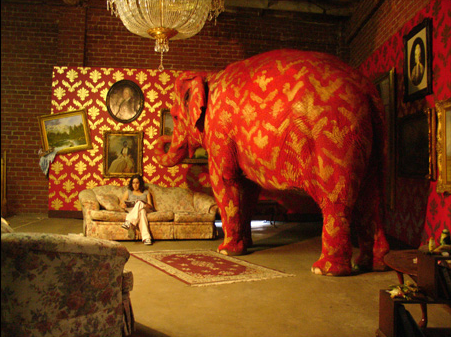
Banksy exhibition...gallery-style


See this great text by Valerie Palmer about a recent Banksy exhibition. The elephant was apparently a fitting centerpiece and stole the show from the political ideas we're used to seeing from the British sweet-painting rebel. Bottom line:
The power of his work lies in the way it interacts with its environment and that obviously gets lost when you put it in any kind of gallery setting.
I guess my wish came true.
Question: Is there any way for revolution to go mainstream?
My answer: No.
Question: What about Cattelan?
My answer: Come on, that's softball compared to Banksy. Cattelan's subversion is a Viennese Waltz compared to Banksy's creative punk attitude.
Question: So how can a guy like Banksy gain recognition?
My answer: He's got it already.
Question: More recognition?
My answer: What's the point? To "promote his values"? Let's face it: the value of critique is that it criticizes. Once it becomes part of the game, it smells of hypocrisy.
Question: What about subversion? Isn't that an option?
My answer: Possibly.
My answer after having though about it for a minute: But there's something cynical about it, isn't there? While in the case of Banksy, there hasn't been so far.
Question: Well, how is he supposed to make a decent living?
My answer: I don't know - find a sponsor? Hell, if I knew, I would be doing it already.
My alternative answer: Just as the jester's role used to be an intelligent critique, also of the ruler, and he made a living off it, so there might be room for an official jester... In the best of possible worlds, that is.

Selasa, 19 September 2006

Style. Beyond the individual


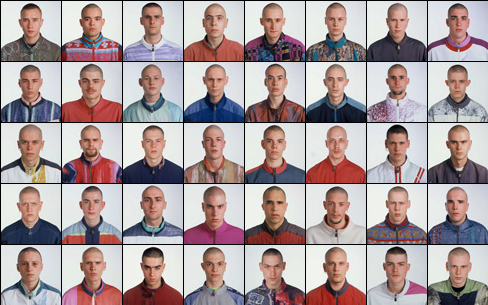
Exactitudes (= exact attitudes), by photographer Ari Versluis and stylist Ellie Uyttenbroek, is an exercise in style (or rather was, from 1994 to 2002 - it is now present online, in a traveling exhibition and in the form of a book). Style is what makes the person unique, but also, quite paradoxically, what makes her so easily categorized. Some say the search for identity isn't at all a search for authenticity (which is a controversial concept), but rather, a search for style. Identity, here, would mean a sort of a definition that allows one to make a drawing. So here we have it, those young boys are making the drawing of themselves - they are getting themselves defined, they are become unique, and totally anonymous at the same time.
It is quite an exciting balance/game/tension, between the self-as-unique and the self-as-participating. Exactitudes shows it clearly. Maybe a little too clearly. It might be because the work is somehow dated, and that, beyond the fact that styles have evolved quite a bit (another proof that identity might be more about style than we think). The pictures, their esthetic qualities, but also the way it was made: the styling, the forcing into categories. Is it necessary? The argument, found in the "about" part of the page, that everything is stylized anyway, simply doesn't seem enough. That's why the groups that speak most to me are ones where the difference, and the similitude, are there, impossible to hide, like in the Tattoo Babes series, or the Dreads one. The others often seem forced, as if the similarity sometimes wasn't enough and needed to be underscored - and it really needn't! Maybe in these two cases, the presence of the naked body seems like something more honest, less manipulated? Then again, come and think of it, the tattoos could be fake.

Sabtu, 16 September 2006

Al Magnus: taking children seriously

For Al Magnus, it all started with having children.

How surprizing is that? Of course, these are images of fairly tales. Some actually ring a bell. Most are rather fairy tales in themselves. But to start off, remember they were not meant for us, but for the little ones. Hopefully, that can be a good enough excuse to enjoy, as we usually enjoy the things that weren't meant for us.

Then, of course, there is more. The above image, called Paisagiste II (Landscape Designer II) has two versions. The first one is in color. This one, however, is quite different. By taking away the color, the general atmosphere becomes heavier. But there is another change. The boy pulling on the rope all but disappears. (Yes, there is a boy pulling on the rope). Suddenly, we discover the designer is not quite the one we thought it were. Maybe, because in the tales we know, we can only think of one designer.
But isn't the designer someone with the power to reinvent? To construct, but also, to make a Very Silly Thing (La Grosse Betise)?
Maybe, the power of attraction of children's tales is not that they're far-fetched, incredible, fantastic, but that they design things in such a way that we feel this world-changing design on every step? This is a big difference, since we rarely associate children's stories with the creation of order. Come to think of it, it is an order that they have in common with some, maybe not all, art. And so, the trivial idea that artists are the adults that remained (or went back to being) children can be understood in a whole different way. Artists treat designing seriously.


Rabu, 13 September 2006

For V.

The work, by Maarten Vanden Eynde, is called Rave Nature, but here is something interesting: the photo's file on the artist's server is named podium. I much prefer this second name. Also, as we can read here, contrary to many other works of land art, the work as such was not the picture, but the thing itself. It was part of a festival, and was actually an installation that at night would be lit with disco lights and a stroboscope, and smoke would come out while a song would play... I'm not really sure if I still enjoy it as much. One thing is for sure: this picture certainly doesn't convey the idea of rave. Which might be part of the trick, come to think of it. As if the stage was set, but impossible to comprehend during daylight? On a more general level, it's fascinating how the opening of interpretations, as would be the case without the night party, leaving the stage as is, at the same time attracts (makes it more enigmatic) and repels (oh, yah, I get it, conceptual work, got the concept, let's go). Is it cat vs. dog? Is it about the work (over)interpreting itself? Two other pieces by the artist I particularly appreciated:

Both are from the Genetologic Research series. The second one seems to only really gain power when seen in the physical space, but we get the point.

Remixing stuffed birds


Pour les dents d'un blanc éclatant e saines (meaning: for teeth that are shining white and healthy) is an installation by Jeroen Diepenmaat. In it, stuffed birds play records by putting their bill into the groove. One of the impressive things about it is that it's not one of those suggestive works that actually only work as a symbol. It works! On his site you can listen to the sound this and other installations make, or you can choose to chill out to some collaborative re-mixing he's been making. All his works seem to be evolving around vinyl and old cars, and often include interesting ways of callaborating with others (artist, students, groups of unsuspecting passers-by...). Speaking of vinyl, it's impressive how old-style vinyl lovers keep reinventing themselves. Is there anything better for creativity than apparently disqalifying limits? Could this be a difference between the amateur and the professional? The amateur doesn't need limits to his areas of investigation...
(via)

Selasa, 12 September 2006

In these dark days

Oh, entertain me, do entertain me, make silly things, funny things, call them art, call them rat, but make them pleasant and direct and, why not, simple, and use the tongue of greatest lovers, the tongue that tickles, that brings emotions to the flower of the skin, as the Portuguese like to say...


More here.

He's for a jig or a tale of bawdry, or else he sleeps. - Hamlet


(via)