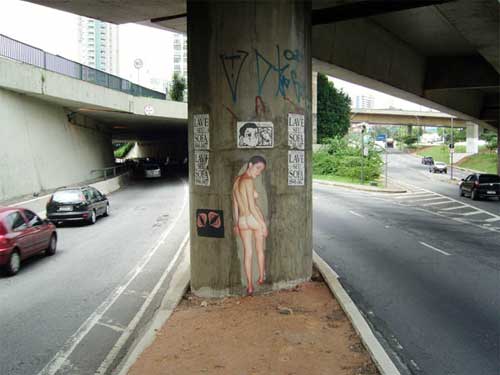
(Click on the image above) The video is apparently by one Johan van Hensbergen.
Technorati:
(Click on the image above) The video is apparently by one Johan van Hensbergen.
from an interview with Jack Vettriano"I just consider myself a trader. I take my goods to the marketplace and try to get the best price I can."
The greater glory of art doesn't come into it, he confirms. "That's not why I paint," he said. "It's wall decoration for me, I don't regard it as this big meaningful thing. My subjects are men and women getting off, that's all. Mind you, some people don't think sex is serious, but I happen to think it's terribly serious."
 On the picture are "women and crosses and coffins on a beach in Santa Monica", a few days ago.
 Why does this answer scare me even more? Am I being way too conservative? Besides being an artistic work, it is also a social statement. Yet, somehow, it seems to provoke both sides, the islamic culture and the "Western rationalism". Yes, I think I like this chill down my spine. There is something wrong with the picture, because there is something wrong with the sudden proximity of tradition in its most limiting sense and modernity in its most limiting sense. Seen from the point of view of the other, they both might seem ridiculous. And they could, if they wished to, listen more carefuly to who the other one is. On both sides.
 , comes to mind: are we better because we wash twice a day? Are we better because we have a method for writing down our history? Because we own what we call rationalism? How many of us own it, to be precise? But, if we accept the "barbarians", if we embrace the other, either in our tolerance and/or in our wish to enrich ourselves, who are we? And if we are the other, and decide to take some of this otherness in parantheses, as the vast majority of religious people do today, as do people from influencial cultural backgrounds, who are we then?
 Rosemarie Trockel, Schizo-pullover (1988)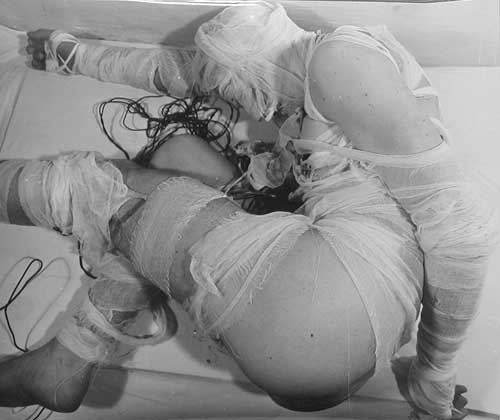


What may come as a surprize is that this objectification can actually get us closer to the identity of the people. We feel empathy for Sierra's performers; we somehow refuse to see pure objects in Beecroft's girls. We feel obliged (yes, a moral category!) to project on them a presumed humanity, to see them as people, to ask ourselves about them, about their position, role, about why they are doing what they are doing and why we are doing what we are. This brings another point,

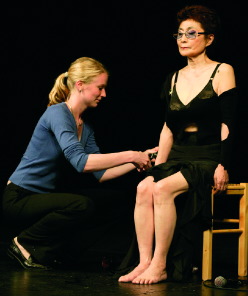
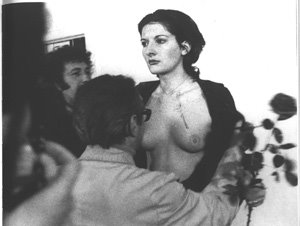
They all share a space of intimacy, of sharing, of actually living together. This is a game of acknowledgement, of personal limits being overcome. It is creating a space where it is difficult for me to say something is simply a "good" or "bad" show, because I get involved (remember the Bill T. Jones case?). I don't need to actually be a "participant", i.e. I don't need to be performing an action, but I need to feel that the bond between me and what is happening on the "stage" (or in the "framework", to use an excellent term by the great Irving Goffman), that this bond goes beyond a show.