Senin, 28 November 2005

Art-of-Focus

Michael Takeo Madruger's net art works on Turbulence are calm, seemingly monotonous. They fear focus as dates fear the morning - it takes away the clarity of feel. Some of them are quite political, others personal, all of them seem to play with our ability to see - or rather, to almost see. (there is a wonderful Portuguese verb for that - "vislumbrar" - to appear in an unclear way). Re_collection is one of them, a short piece where "nothing" actually means a lot, where every pixel fights for expression - until they manage. Don't waste too much time reading the project description - at least not before you see it.

Sabtu, 26 November 2005

Another Polish controversial art scandal

I have never seen the Polish performance group Suka Off live. Which means I am not a very comptent person when it comes to judging their shows.
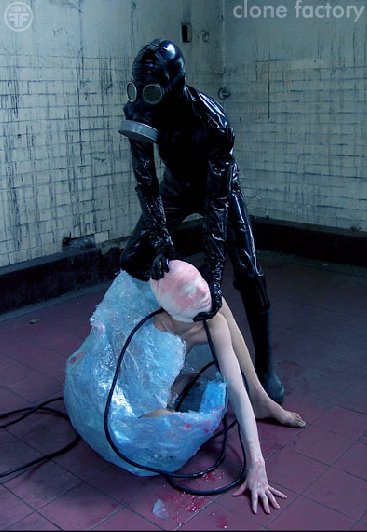
But several influential people in Poland recently decided that it really doesn't matter. If you know the story, or have seen a picture or two, you basically can decide if something is respectable, or, as has been in the case of Suka Off, if it's just "disgusting pornography" and should be burned down, destroyed, killed and rot in hell, where it belongs. It all started with an article in the tabloid Fakt, which stated "They call this disgusting stuff art!" and "This is pure pornography!". The journalist didn't see the show - but saw the pictures. Then, a politician read the article, and decided it was time to do something about it. He didn't see the show, only read the article. And he put the case to court, declaring it a case of "distribution of pornography" (illegal in Poland). Some other politicians felt the need to confirm the hienous nature of the show. A few old, renowned directors said how horrible this was. One of them, Hanuszkiewicz, used to make scandals himself, putting motorbikes in the National Theater (in the middle of the comunist era!), and such. Now he's old and his productions are aweful - but he is the perfect "judge" of the situation.
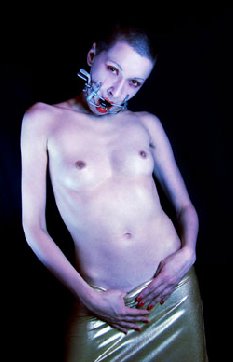
The next day after the original article appeared, Suka Off got dished from the program of an alternative theater festival. Its director now says it was for "financial reasons".
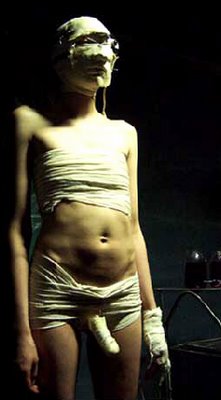
I will not write about the originality of the show, or the lack of it, for that matter. I don't know much more than a few descriptions (imitating fucking, pissing, hurting oneself). I like the pictures, though have seen not-too-different ones before. It could be as good or as bad as anything, but damn it, it's there, and it's the 21st century or so they say, and Poland looks like a joke. A sad joke.
Suka Off have self-censored their pretty site as a form of protest. (you can see it through here though - in Polish)
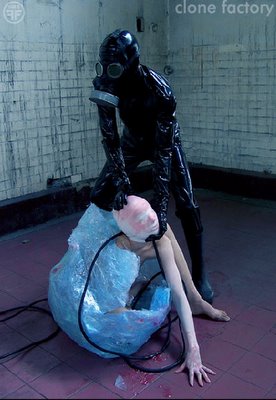
NB: It's amazing how short-lived people's memory of live (performing) art is. And to some extent, it is natural, since they really did not see the Abramovićs, the Gina Panes, Chris Burdens, or the viennese actionists. Is that another reason why history repeats itself? Because it's not film?

Selasa, 22 November 2005

Bad gender art?

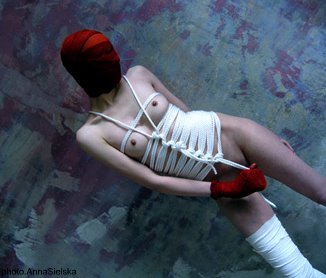
I've been thinking about my last post. What do I actually think of this feminist art revival? The question is: can we judge it as good or bad art? Why does it appear to be an ethical and not aesthetic choice? I mean, say I appreciate this type of art. Could I still consider one of these works bad art? The critics, all of them, don't seem to give me that choice: either you are avant-garde and therefore love it, or have another system of values which disqualifies this art altogether. This is a very irritating phenomenon that also happens in other forms of artistic expression where important life values are at stake. It is as if the issues were so important, the art part of art is nearly irrelevant. That's a pity - because the quality of a work not only goes beyond its concept (that's trivial), but also engages the spectator in a specific way. This engagement, this relationship, is what I might call quality, and it is what seems to matter no less than the "intention" or "concept" or so. The spectator could be a hypothetical one, but he is still part of the works dialogical being, so to speak. From the works shown below, I find Kozyra's piece stronger than Żebrowska's, because it goes deeper, on more levels, and it attracts me aesthetically, whereas Żebrowska's work, not for the first time, I find discomforting, almost unappealing, as in - weak. I can very well imagine a cross, a penis, and some other forms sliding out of a vagina, and they would seem to "work" - but there is something just too simple about it, naive, one-sided. Kozyra, on the other hand, manages (once again) to keep the balance in her ambiguity. She confuses us, makes us shake our heads, and then answer, and then ask again. And it's this constant coming back to a question I particularly appreciate.
And yet, once again I ask: is this sort of art fair?

Senin, 21 November 2005

Sex, Art, Feminism and national culture

The Gallery of Polish 20th-Century Art at the Krakow National Museum just reopened (Polish link) with a brand new look. (Unfortunately, this doesn't apply to the Museum's website, which still seems like an archaeological exhibit rather than an important European venue and isn't even translated into English)
Among the various new elements, presence of the "youngest" generation is quite a novelty, as so far anyone born after 1939 and/or using any other means than oil on canvas or marble wasn't welcome at national (permanent) exhibitions.
This wasn't an easy step. Poland has a problem with tradition. It is defined through culture, which is defined through art, and thus artists are turned into monuments, and desired dead or at least "understandable", i.e., consistent with what had already happened before in art and (Polish) history. Recently, though, the Polish art world seems to be slowly waking up from the romantic dream of our "great forefathers", to discover that the artists haven't been sleeping, and their creations are as rich and diversified as pretty much anywhere else in the bad, bad, commercialized and rotten world we live in.
No awakening would be real without a few controversies. One of the major ones in Poland are women artists speaking of the female condition, graphically, shockingly, without the customary shyness or estheticizing. Sex is there, gender plays funny games, culture meets nature just to fight it till death over who we are, and how.
I found an interesting article by Paweł Leszkowicz about this new generation of Polish women artists. Some of it I agree with, some of it is speculation or stretching the limits of interpretation, but it's an interesting look at an important voice in the contemporary discussion about sex, gender and identity. As to the affirmation that "the critical violations of women’s art expose the violence of sexual inequality hidden under layers of democratic jargon and religion-turned-ideology", hopefuly this reinvented gallery at the Krakow National Museum will be an important step in proving, or rather making, this statement a false one.

Alicja Żebrowska, Original Sin (still) (1994)


Katarzyna Kozyra, Bonds of Blood (1999)

(you can find more about contemporary Polish feminist art here and here)

Selasa, 15 November 2005

Wodiczko in Warsaw

We have to see the relationship between what is being said and how it’s being transmitted. For people to open up and come closer to those who are conveying difficult truths, it may be easier through a spectacular project. So there is a function of the spectacular here, an artifice that is more acceptable because of its aesthetic quality.
- Krzysztof Wodiczko

The Polish artist Krzysztof Wodiczko rarely exhibits in Poland. Actually, I believe his projection at the famous Zacheta national gallery was his second appearance in Poland (he hasn't been living in Poland for a while now).
Here is a report I received from my mother (yes, my mom):

I think it was an excellent piece of work. Cariatides - young women holding up the building - were created by a projection of film on the Gallery pillars. And they talk, they talk about the violence of men towards them. Without pathos, without sentimentalism. Some women are older, some younger, some sob, other are rather cold. The projection shows them in pairs, or at times the same woman is projected on both pillars. Each of these couples has a dramatic form of expression, they were directed, but not too much, there is a rhythm in what they say, sometimes the words of one woman are a comment to the words of another. There is no fix rule, nothing is repeated, the whole thing lasts 20 minutes.
But it's a pity, a great pity that it wasn't created in a more busy place, one that would be seen from the crowded bus stops, or at some train station; the formal idea were the Cariatides and that's where the choice of the Zacheta building came from [it's a neo-classical building with large columns in front of it], but this way the main objective of the showing is putting it in Wodiczko's portfolio and the comments of critics, and this way the work becomes accompanied by some falsehood. Because if the final filmed monologue is an appeal to women - not being able to count on help from outside - to be careful and not raise their sons as future bastards, as this is the only thing they can do and this is the only chance for a change in the next generation; so if this is the message of the work, then if it is seen by a group of +-300 people, in their vast majority amators of contemporary art, then doesn't the mountain give birth to a mouse?


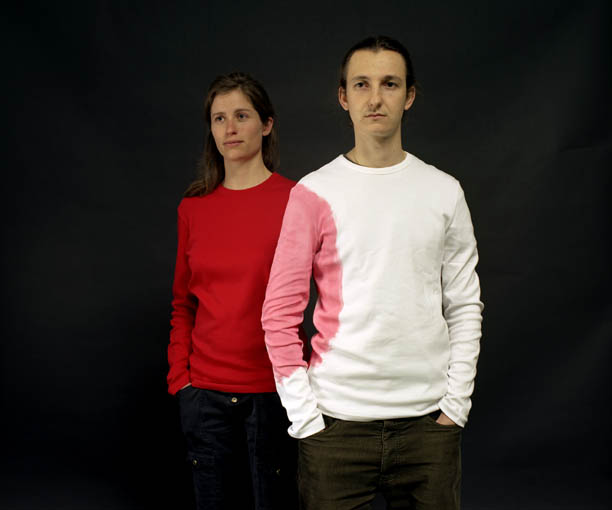
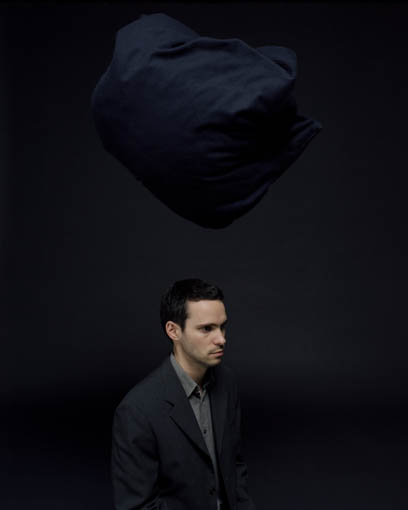
NB: Unfortunately I don't have any images of the Zacheta event. The pictures are from Wodiczko's previous initiatives. Here is an interesting interview with the artist.