What we need is a point of view.
Somewhere to look from.
And then, somewhere to look to. That might just be the landscape.
Whatever frees itself from the arms of focus to go behind, outside, further, deeper.
Focusing on landscape is an oxymoron.
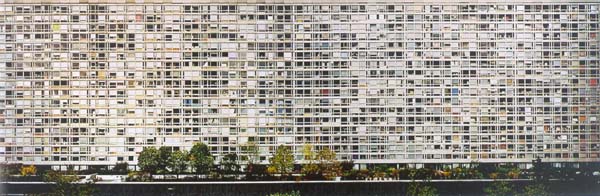
Try focusing on
Andreas Gursky's house

Oh but this is not a landscape
(says someone).
This is a house. But of course, it is a landscape, exactly because we get lost in it. A house, namely, this house, may very well be a landscape.
To put it more positively: landscape envelops our sight.
I like that.
The seminar I participated in, about New Ways of Approaching the Landscape, had an incredible diversity of people using this envelop. There was a land artist, a scholar studying the aesthetic aspects of landscape, a photographer, a cinema director, a digital photo effects specialist (hence the Gursky reference above...) and a multimedia artist working with(in) landscape.
Of course, each of them spoke about a somewhat different landscape. Each of them caught me off guards in a specific, particular way. What became clear was that, somehow, landscape has become an object. How can one objectify what we can't even focus? (someone asks)
I guess it is the simple fact of the sight being a construction that turns our sights into objects. But this doesn't seem to answer the question, as landscape is considered precisely this outer limit of our sight's grasp. Maybe it instinctively guarantees some sort of firm ground? And yes, let's admit it: this guarantee is false. Which is bad news for the believers, and great news for the manipulators - artists. Suddenly, the artist's playground extends beyond the
sic et nunc of his focus. It gains a haziness that irritates the precise purist minds and fascinates the romantics. It creates the challenge of containing
space. That is what constitutes the paradox of art dealing with landscape: it confines the thing defined through openness. That is why a picture of a landscape at the same time seems the most direct way of representing landscape, and the most false one - as the frame kills space.
 Liz Larner, Corridor Orange/Blue, 1991
At the seminar, the philosopher Nuno Nabais introduced the topic by referring to landscape (as art) as a way of applying Kant's concept of the
sublime to art. One of the main characteristics would be its limitless quality. Kant opposes the sublime to the beautiful - the sublime has no limits, no balance, no order, while the beautiful has all these qualities. Could we thus say that artists that work with the landscape approach the sublime with the instruments of beauty?
(The speakers during the seminar were: Claudio Melo, Duarte Belo, Ivan Franco, Maria Lino, Nuno Mendoca, Nuno Nabais, Sandro Aguilar) Enrique Zabala, Isn't It Colder 05 (2004)
I'll be spending the next four days on an artistic residence in northern Portugal, that came about as a continuation of
ArtLAB's seminar and a second part of the Landscape workshop. I'll try posting from there.
 It's pretty clear this is not Bacon. And it's pretty clear it's close, but later, oh, so much later, more angry, desperate, less attentive to the gentle tones melancholy brings to cool you, to ease the mad desire for pain.